Service 05
Drain issues: local clog, main line, or venting?
Drainage runs on gravity and air. When water slows down, the useful question is not what is stuck but how many fixtures are affected and whether anything gurgles — because those two answers separate a trap you can clean from a line that needs equipment.
Design conceptTriage
Count the fixtures first
Before anything else, run water at several fixtures and note which ones misbehave. That count is the fastest route to the right scope.
One fixture only
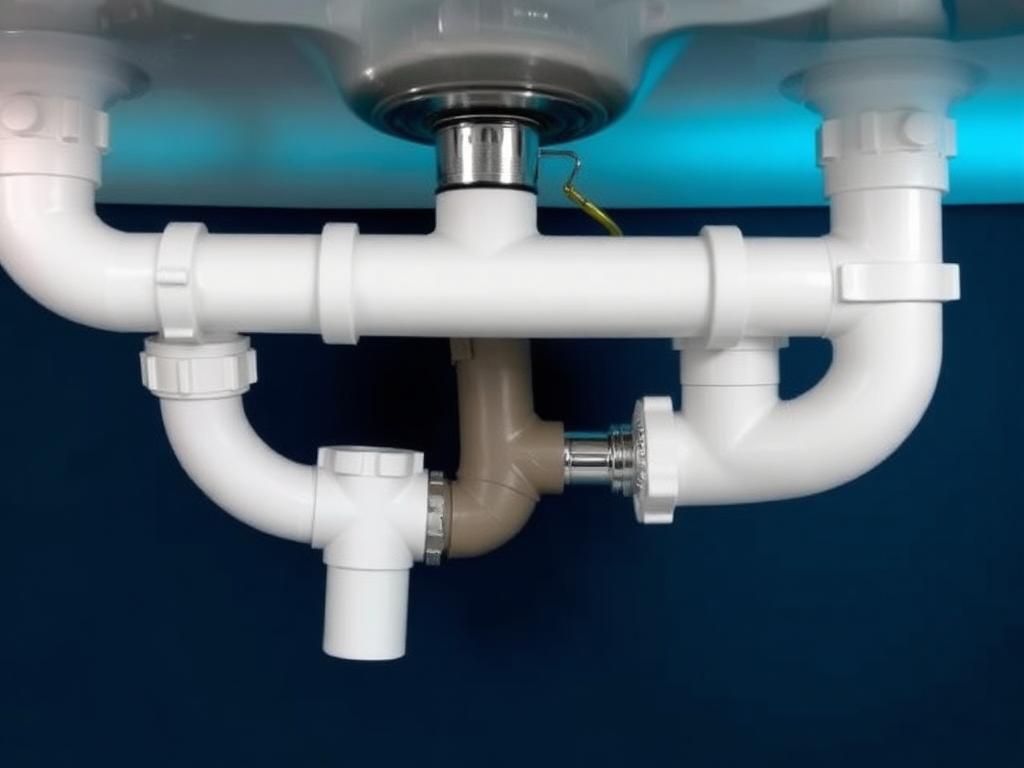
Almost always local: the trap, the tailpiece, or the short branch behind it. A lavatory pop-up assembly collects hair right where you cannot see it, and a kitchen trap collects congealed grease.
Several fixtures in one bathroom
Points to the branch drain serving that group rather than any single trap. Worth checking whether the lowest fixture in the group is the first to back up.
Fixtures across the house
Suggests the main line or a venting problem. Water rising in a tub when a toilet flushes is a classic version, and it is not solved at any individual fixture.
Causes
What actually accumulates in residential drains
Line → typical accumulation
| Where | What builds up |
|---|---|
| Lavatory basin | Hair bound with soap around the pop-up stopper and in the trap bend. |
| Kitchen sink | Cooled fats and oils coating the pipe wall, catching food particles over time. |
| Shower and tub | Hair, soap residue, and mineral scale at the strainer and just below it. |
| Laundry drain | Lint and detergent residue, sometimes with a high-volume discharge overwhelming an undersized line. |
| Main line | Accumulated grease, wipes and other non-flushables, and in older properties root intrusion at joints. |
| Vent stack | Debris, nests, or a blockage at the roof terminal, which shows up as gurgling rather than slow flow. |
Approach
How a drain gets cleared sensibly
Mechanical before chemical
Pulling and cleaning a trap, or clearing the line with the right cable or head, addresses the actual obstruction rather than partially dissolving the top of it.
Access from the right point
A cleanout, a removed trap, or a pulled toilet each give access to different parts of the system. Choosing the closest sensible access reduces both time and mess.
Clear the length, not just the plug
Punching a hole through a grease layer restores flow briefly. Working the full affected length is what makes the difference between weeks and much longer.
Check venting if gurgling continues
Flow that improves but still gurgles suggests the air side of the system, which is a separate investigation from the water side.
Ask why it happened
Repeat blockages in the same place often mean a slope, sizing, or line-condition issue that no amount of clearing will change.
Habits that genuinely help
Stop if sewage backs up
Questions
About drains
One drain is slow. Is that a main line problem?
Usually not. A single slow fixture points to its own trap or branch — hair and soap in a lavatory, grease and food in a kitchen line. Main-line problems tend to affect the lowest fixtures first and show up at more than one place at once.
Why does my tub fill when the toilet flushes?
Because the two share a drain and something downstream of both is restricted, so water takes the next available opening — the lowest one. That combination is a common sign that the problem is in the shared line rather than in either fixture.
What causes gurgling from a drain?
Air being pulled through the water in a trap. That happens when the vent system cannot supply air normally, either because a vent is blocked or because a partial obstruction is forcing the drain to draw air from the nearest trap. Gurgling is a venting clue, not just a clog clue.
Why does a rarely used drain smell?
Every trap holds a small plug of water that blocks sewer gas. In a guest bathroom or a floor drain that is never used, that water evaporates — especially in a conditioned, dry-air space — and the barrier disappears. Pouring a cup or two of water into the drain usually restores it.
Working out what your plumbing problem actually is?
Note what you can observe — where the water shows up, when it started, and what you already tried, then call. The assistant can also check open times and schedule a visit once you confirm the details.